

Retail execution is where CPG strategy meets real store conditions. A brand can have strong products, good pricing, and planned promotions, but still lose ground if shelves are empty or displays are wrong. Field teams need more than a checkbox saying a store was visited. They need to capture what actually happened in the aisle, from shelf checks and planogram photos to merchandising notes and account follow-up. Retail execution software should turn store visits into useful field data, not another pile of manual reports.
Consumer goods brands choose these tools for different reasons. Some need store audits and photo proof, while others need merchandising workflows, manager visibility, or retail execution tied to orders, invoices, delivery, and DSD. That difference matters because a pure audit tool will not solve the same problems as a platform connected to sales and delivery work. This article focuses on systems that help field teams document, manage, and improve what happens inside retail accounts. The right choice depends on whether execution is a standalone process or part of a wider field operation.
How These Platforms Were Selected
The Top 4 were selected to cover different retail execution needs, not just to list the largest names in the category. SimplyDepo fits teams that want retail execution connected with sales, delivery, invoicing, and QuickBooks Online sync. Repsly is stronger when the main job is merchandising, store visits, photo proof, and field team visibility. StayinFront is built for larger consumer goods teams that need broader field sales and retail execution management. ParallelDots ShelfWatch fits brands that care most about AI shelf recognition and image-based shelf insights.
The goal is to make the comparison easier before a buyer gets lost in long product pages. Each company below represents a different practical scenario for a CPG team. Some are better for reps who sell and deliver during the same visit, while others are better for audit programs or shelf analytics. Here is the short version of what each platform brings to the table:
- SimplyDepo for CPG teams that want retail execution tied to field sales, invoicing, delivery proof, and QuickBooks Online sync;
- Repsly for brands that mainly need store visits, merchandising checks, photos, and field team visibility;
- StayinFront for larger consumer goods teams that need broader field sales and retail execution management;
- ParallelDots ShelfWatch for companies that want AI shelf recognition, photo analysis, and shelf-level insights.
The list is ranked by practical fit for consumer goods workflows, not only by size or feature count. A platform can be excellent in one scenario and still be the wrong choice for another team.
1. SimplyDepo

SimplyDepo is the best fit for self-distributing CPG brands that want retail execution inside the same mobile workflow as field sales, order capture, invoicing, route work, and delivery proof. SimplyDepo retail execution software addresses a common field problem: reps often check shelves, take photos, create orders, invoice customers, and support delivery during one store visit. Instead of pushing those tasks into separate apps, SimplyDepo keeps them in one workflow with QuickBooks Online sync, offline access, Stripe payments, shelf audits, planogram photos, and store notes. That makes it useful for teams where selling, delivery, and merchandising overlap in the real world. It is strongest when retail execution should not live as a separate audit layer.
This matters because store execution data is more useful when it sits next to customer activity, orders, invoices, route history, and delivery proof. A rep can document the shelf, capture the order, invoice the customer, and move to the next stop without rebuilding the visit later in another system. For managers, this means fewer gaps between what happened in the store and what appears in the back office. The platform is strongest for US and Canadian teams using QuickBooks Online. It is not aimed at global enterprise operations with deep ERP requirements or standalone audit-only programs.
SimplyDepo’s value is not just that it can capture a store photo. The bigger point is that the photo, order, invoice, delivery proof, and customer record can sit closer together. That gives CPG teams a clearer view of the whole visit instead of only one isolated task. Its strongest areas include:
- Shelf audits, planogram photos, and store visit notes;
- Mobile order capture for reps working with retail accounts;
- Delivery proof, mobile invoicing, and Stripe payment collection;
- Offline access for reps, drivers, and merchandisers;
- Two-way QuickBooks Online sync for cleaner records.
SimplyDepo is a strong choice when retail execution, field sales, and DSD need to work together. It is less suited to companies that only need enterprise audit programs with no ordering, invoicing, or delivery workflow.
2. Repsly
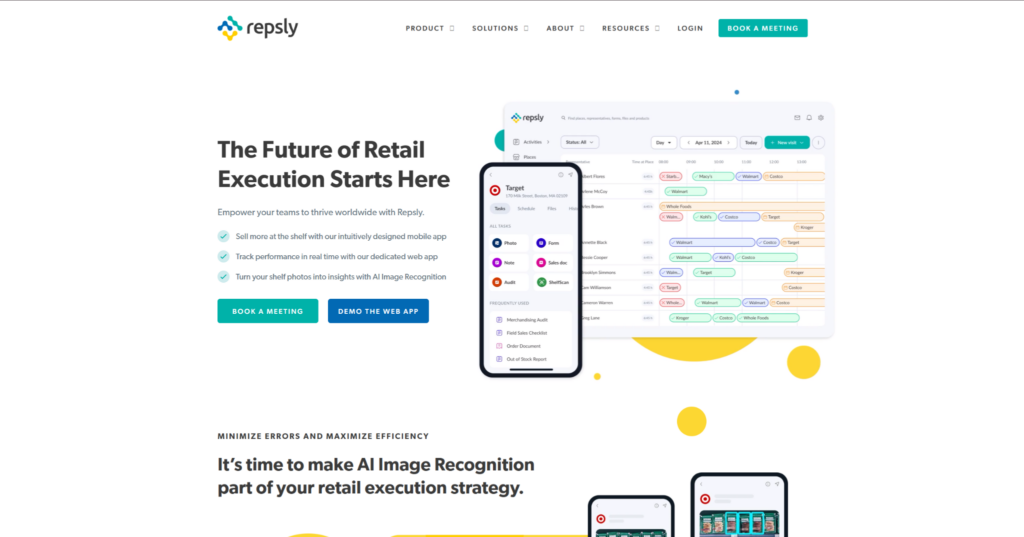
Repsly is a retail execution and field team platform for brands that need better store-level visibility. It focuses on merchandising, visit reports, photos, retail account checks, and manager oversight. The platform is useful when teams need proof of what happened in the store rather than loose notes from reps at the end of the week. For merchandising-focused teams, that kind of visibility can make store programs easier to manage. Repsly is strongest when retail execution itself is the main job.
The difference between Repsly and a DSD-first system is important. Repsly is better suited to tracking store execution than managing the full order-to-delivery process. Teams that need sales orders, mobile invoicing, delivery proof, payments, and accounting sync may need another system alongside it. That is not a flaw if the company’s main priority is merchandising control. Buyers should look at Repsly when store execution data is the main output they need from the field.
Repsly should be judged by how well it helps brands understand what happens across stores. Its value lies in visibility, reporting, and merchandising discipline rather than route sales or invoicing. The platform is most relevant when managers need more reliable store-level evidence. Useful areas include:
- Store visit tracking for merchandising and field teams;
- Photo reporting for shelf and display checks;
- Manager visibility into rep activity and field execution;
- Tools for retail account reporting;
- Support for merchandising-focused workflows.
Repsly is a strong option for brands that need store visibility and merchandising control. It is less complete for CPG teams that want retail execution connected to sales, invoicing, and delivery in one app.
3. StayinFront
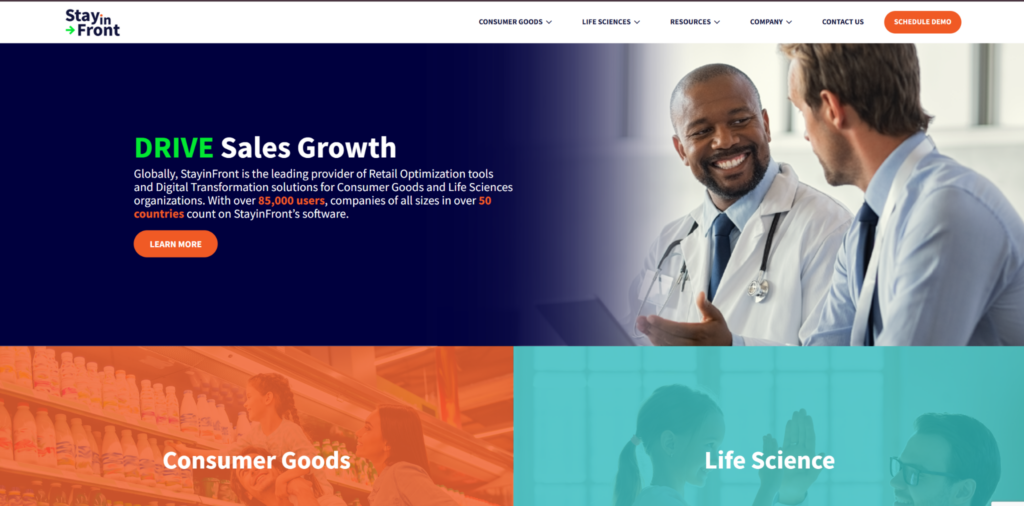
StayinFront is a broader retail execution and field sales platform for consumer goods companies. It fits larger teams that need rep visibility, store activity tracking, retail optimization, and structured field sales tools. The platform can support more mature field operations where managers need oversight across accounts, routes, reps, and store programs. That makes it relevant for companies with larger territories and more complex field processes. StayinFront is a serious option for teams that have outgrown basic field tools.
At the same time, it may be more enterprise-oriented than smaller CPG brands need. A larger system can bring better structure, but it can also require more rollout planning, admin work, and internal coordination. Smaller teams should look carefully at daily usability before committing to a platform with more moving parts. StayinFront’s value is strongest when retail execution is part of a broader consumer goods field operation. It belongs on the list because some brands need more than simple visit tracking or shelf photos.
StayinFront is useful when a company needs structure across sales reps and retail execution work. It should be evaluated by how well it supports field management, store-level control, and larger account coverage. The platform makes the most sense for teams that need visibility across many reps and territories. Key areas include:
- Retail execution tracking for field teams;
- Store visit and activity management;
- Field sales tools for consumer goods reps;
- Manager visibility across accounts and territories;
- Support for larger CPG field operations.
StayinFront is a strong choice for larger consumer goods teams with more developed field operations. Smaller self-distributing brands should compare it against faster, more focused tools before committing.
4. ParallelDots ShelfWatch
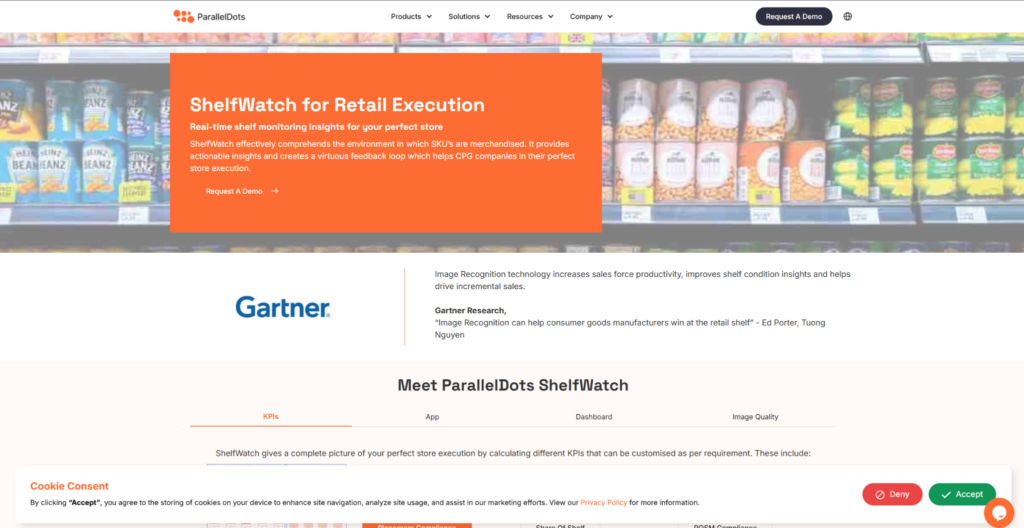
ParallelDots ShelfWatch is an AI shelf analytics and image recognition platform for retail execution. It focuses on shelf photos, product recognition, planogram checks, share of shelf, out-of-stock detection, and retail visibility. This makes it different from classic field sales or DSD tools because its main value comes from analyzing shelf conditions from images. For brands with many store visits and large audit programs, that kind of automation can be useful. ShelfWatch is strongest when photo-based shelf data matters more than order or delivery workflows.
The platform can help brands turn shelf images into structured insights, but it does not replace order capture, invoicing, route work, or delivery proof. That distinction is important for CPG teams, comparing it with broader field platforms. A company may use ShelfWatch alongside a field sales or DSD tool if shelf analysis is a major priority. It is especially relevant for teams with large store networks, frequent shelf audits, or a need for more consistent image-based reporting. ShelfWatch is best viewed as a shelf intelligence platform rather than a full field sales system.
ShelfWatch should be evaluated by the depth of its image analysis and the usefulness of its shelf insights. The focus is on photo analysis, retail visibility, and shelf-level evidence. It is strongest when a brand needs to understand what is happening on the shelf at scale. Key areas include:
- AI shelf recognition from store photos;
- Planogram checks and shelf compliance analysis;
- Out-of-stock and share-of-shelf visibility;
- Photo-based retail execution insights;
- Useful support for large-scale shelf audits.
ShelfWatch is a strong fit for brands that need shelf analytics at scale. It is not the right standalone choice for teams that also need DSD, mobile invoicing, payments, and delivery proof.
Choosing the Right Retail Execution Tool
The right retail execution platform depends on what field teams actually do during store visits. If retail execution happens during the same visit as sales, delivery, invoicing, and account management, SimplyDepo is the more practical choice. If the team mainly needs merchandising reports and visit proof, Repsly can be a better fit. If the operation is larger and needs broader field management, StayinFront deserves attention. If the main pain is shelf recognition and image-based insights, ShelfWatch makes more sense.
The mistake is choosing by category name instead of matching the tool to the field workflow.
Final Thoughts
Retail execution software should help brands see what is really happening in stores. Shelf checks, photos, merchandising notes, store audits, and manager visibility all matter, but not every team needs them in the same way. Some brands need a standalone audit tool, while others need retail execution connected to field sales, invoicing, delivery proof, and DSD. That is why no single platform is automatically the best choice for every company. The stronger option is the one that removes manual reporting without creating more work after the visit.
SimplyDepo is strongest for self-distributing CPG brands that want retail execution connected to the rest of the field workflow. Repsly, StayinFront, and ShelfWatch can still be good choices when the need is more focused on merchandising, enterprise field operations, or shelf analytics. The important thing is to know whether your field team is only checking stores or also selling, invoicing, and supporting delivery. If those activities happen together, the software should reflect that. Choose the platform that gives managers reliable store-level data and keeps reps from rebuilding the same visit in multiple systems.