

The people running crypto exchanges in 2023 had a different set of problems. They picked Lithuania, filled out some forms, and waited. That was it.
Now, regulators ask about your transaction monitoring software before they even look at your business plan. They want to meet your compliance officer. They request three years of financial projections. The bar moved.
The firms handling this work changed, too. General business lawyers who took crypto clients on the side are mostly gone. In their place are specialized legal firms that do nothing else.
Here are five firms that focus exclusively on crypto licensing. Each works differently. Some build structures across multiple countries. Others specialize in fast entry into specific markets. The choice depends on where you want to operate and what kind of support you need after the license arrives.
1. Gofaizen & Sherle
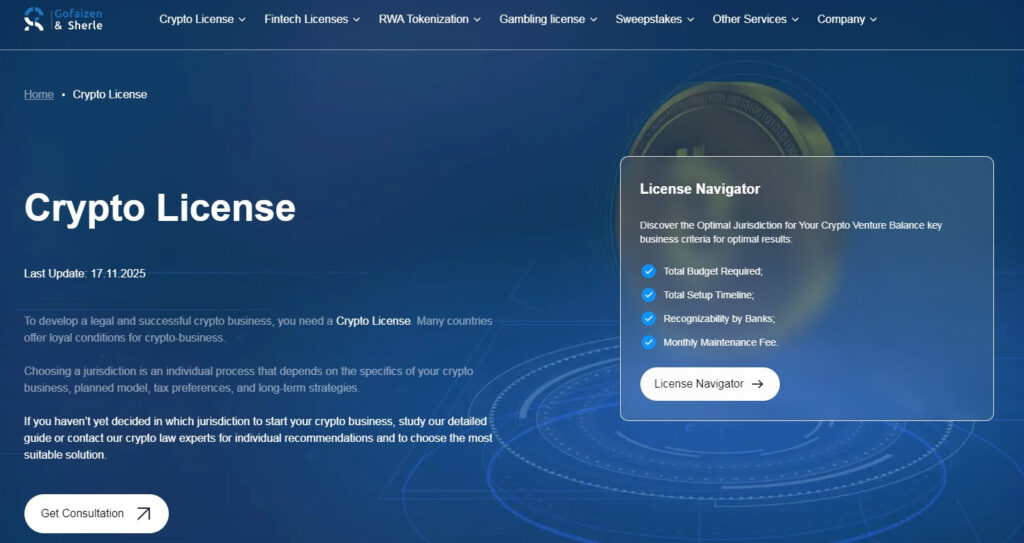
Gofaizen & Sherle is a legal consulting firm for crypto business that does more than file paperwork. They step in during the planning phase, help pick the right jurisdiction, and stay through the compliance checks that come years after the license lands.
Few firms can match the volume of licensing work this team has completed across dozens of countries. Every new application uncovers another layer of how regulators operate and what actually catches their attention.
Their legal consulting services for crypto business setup start with a question most firms skip: where does this business actually belong? They built an in-house tool called Crypto License Navigator that balances:
- Total budget required
- Expected timeline
- Whether banks in that jurisdiction open accounts for crypto firms
- Monthly maintenance costs
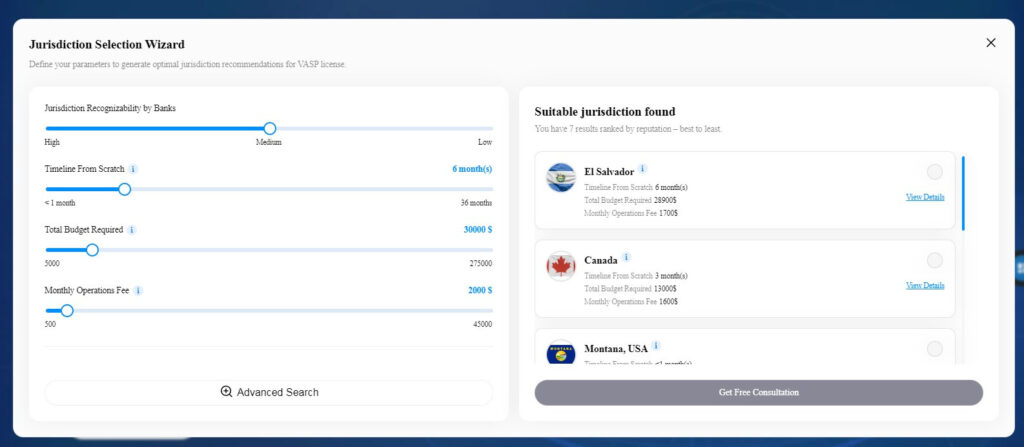
Canada and El Salvador
In Canada, they help clients register with FINTRAC. No minimum capital. Foreign companies can operate without a physical presence. Their legal consultants for crypto licensing navigate both federal AML rules and provincial securities oversight.
In El Salvador, they have secured DASP licenses for multiple clients. Only about 40 companies hold this license. Gofaizen & Sherle clients account for four of them. Corporate income tax on digital asset transactions is zero.
One recent project
They mapped out a three-jurisdiction expansion for Basal Pay: Canada for first entry, Poland for AML reporting support, and El Salvador for DASP licensing. Basal Pay now operates in Canada and is in the final stage of securing its El Salvador license.
Their legal service to obtain a crypto license covers company registration, policy drafting, regulator conversations, and the compliance systems that need to stay running afterward.
- Why they stand out: They act as a specialized legal firm for obtaining a crypto license that builds regulatory structures for long-term growth, not just one-off approvals. Their crypto lawyers work across Europe, North America, Latin America, and Asia. They have helped clients hire over 200 professionals worldwide, including compliance officers and top management.
- Best for: A specialized crypto licensing firm that fits crypto exchanges, custodial services, tokenization platforms, and DeFi projects needing multi-jurisdiction support.
2. Fast Offshore Licenses
Fast Offshore Licenses runs a different operation. Their site lists prices next to license types. Pick one, see the number, and you know the total before any calls happen.
They concentrate on offshore spots like the British Virgin Islands, Cayman Islands, and Panama. The process follows a clear path. Company registration, document collection, and regulator submission, all packaged together.
For El Salvador, they offer three packages. The Basic package runs 12,400 USD and covers company setup, standard AML/KYC policy, and application assistance. The Fully Operational package costs 27,950 USD and includes a custom AML policy, bank account support, and help finding a compliance officer.
El Salvador runs two parallel systems. The Bitcoin Law makes BTC legal tender. The Digital Asset Issuance Law covers everything else: exchanges, custody, token issuance, and multi-asset platforms. The National Commission for Digital Assets serves as the primary licensing authority under LEAD.
The BSP license covers Bitcoin-only operations. The DASP license covers exchanges, custody, brokerage, token issuance, and multi-asset operations. Minimum share capital starts at 2,000 USD, with total project timelines estimated at three to six months.
For crypto businesses that have already settled on a jurisdiction and just need someone to push the application through, this setup works. They also handle VASP licensing under MiCA for EU projects.
- Why they stand out: Clear pricing and a linear process built for founders who want speed without surprise fees.
- Best for: Startups and projects that have picked their jurisdiction already and want a predictable timeline.
3. DLT LAW
DLT LAW has been doing crypto work since 2017, when most firms still treated it as a side project. Their partners came from the industry, not from corporate law firms looking for new clients. Offices in Tel Aviv, Dubai, Limassol, and New York followed as their client base grew across time zones.
Their licensing practice treats applications as projects, not forms. They map out every regulatory touchpoint for a client’s specific services before drafting the first document. When the application goes in, they handle the back-and-forth until approval lands.
Chambers and Partners ranks them in Band 4 for FinTech Legal in Israel. Client feedback mentions their “experienced and international regulatory approach” and “practical approach to global regulatory issues that often have uncertain outcomes.” Another client called them a “fantastic, high-energy young firm” and noted they provide “AAA service like I have never seen at any firm.”
The forensics unit runs separately, tracing transactions and building evidence packages that regulators accept when something goes wrong. They work across the US, EU, UK, UAE, and Asia, but they do not try to cover everything. Their Web3 practice focuses on translating technical decisions into legal and regulatory terms that clients can actually use.
They advised WonderFi Technologies as regulatory and restructuring counsel following its USD 178 million acquisition by Robinhood Markets.
- Why they stand out: A crypto-native practice with forensic capabilities built in. They understand the technical side because they operate inside the ecosystem.
- Best for: Projects that need deep technical understanding and global regulatory coordination.
4. LEXR
LEXR is a Swiss-based legal crypto consulting firm with over 30 legal professionals specializing in blockchain and crypto since 2016. Their services include FINMA no-action letters, SRO affiliation, securities dealer licenses, DLT trading facility licenses, and VASP and CASP setup with ongoing compliance support.
Their crypto practice group includes specialists who have been advising tech and fintech companies for over a decade. Dr. Stephan D. Meyer is recognized internationally for expertise in blockchain and digital assets. Christian leads the crypto practice with extensive experience in successful customer projects.
They run a two-hour workshop for founders who want to understand what they are getting into before paying for a full licensing engagement. The session covers structuring options, compliance strategies, and regulatory requirements with their legal, tax, and regulatory experts. After the workshop, clients get a summary with next steps, timelines, and fee estimates. The cost is CHF 3,800 flat.
Their MiCA white paper drafting service costs 9,500 EUR and covers comprehensive drafting of a MiCA-compliant white paper for utility tokens, memecoins, or governance tokens. They have helped file some of the first MiCA white papers and know the regulation inside out.
While LEXR focuses primarily on Swiss licensing, their legal consulting services for crypto business setup extend to VASP and CASP clients across other European jurisdictions through their network of partner firms.
The firm’s people hold crypto themselves. They use DeFi protocols. They stay current because they are inside the ecosystem, not reading about it from the outside. They lecture on blockchain law, show up at community events, and sit on committees with the Swiss Blockchain Federation.
- Why they stand out: Deep Swiss expertise combined with EU reach. Their paid discovery workshop means clients know exactly what they are signing up for before committing.
- Best for: Projects targeting Switzerland as a base with broader European ambitions.
5. Stalirov & Co
Stalirov & Co provides cryptocurrency legal services designed to launch and scale crypto businesses, with deep expertise in the US, EU, and other key jurisdictions. Their team handles Money Services Business registration with FinCEN and secures state Money Transmitter Licenses across the US.
The firm has supported Intellabridge, a Colorado-based fintech company, through a full legal and compliance review covering Europe, the USA, and Asia. They structured the integration with Prime Trust (US crypto-custodian), Solarisbank (German banking license), and other banks and payment providers.
Their services include company formation in favorable jurisdictions, crypto exchange and custody licenses in Estonia, Malta, and the UAE, AML/KYC compliance programs, and regulatory compliance with SEC, FINRA, CFTC, FinCEN, and FATCA requirements. They also provide tax consulting, GDPR/CCPA compliance, and NFT project launch support.
They operate from offices in Princeton, New Jersey, serving clients across the US and international markets.
Why they stand out: Strong US focus with the ability to handle the complex two-tier system of federal MSB registration and state MTL licensing. They bridge the gap between US requirements and international expansion.
Best for: US-based crypto projects or international firms targeting the American market.
Final Thoughts
The firms listed here all deliver licenses. That is the baseline. The difference shows up after approval.
Some hand you the license and disappear. Others stick around for the compliance reports, the regulator questions, the annual renewals. Some design your corporate structure so you can add jurisdictions later without rebuilding everything from scratch.
A crypto license in 2026 starts a relationship that keeps going. Regulators expect regular reporting. They want to see policy updates. They conduct compliance audits. The license is the beginning, not the finish line.
The question is not just who can get you a license. It is who can keep you licensed. Working with experienced lawyers for obtaining a crypto license means you get more than paperwork. The best legal crypto consulting firms understand this distinction and build their client relationships around long-term operational support rather than one-off transactions.
Pick the firm that matches your actual needs, whether that’s a full-service legal consulting firm for crypto business or a specialist in a single jurisdiction. A multi-jurisdiction strategy requires a different partner than a single license in one country. A US-focused project needs someone who knows the state-by-state MTL system. A European expansion requires MiCA expertise. Match the firm to your plan, and the process becomes something you manage rather than something that manages you.